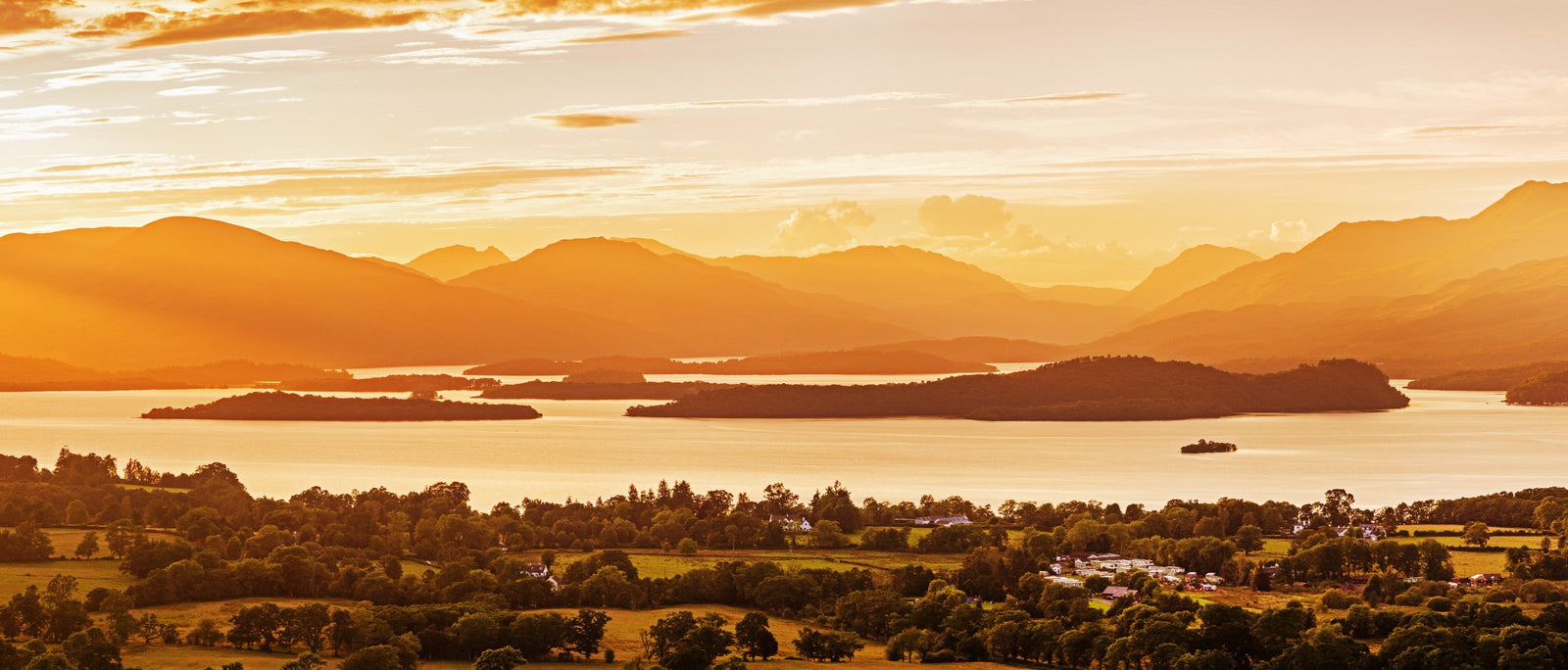

Those of you lucky enough to have attended a Scottish wedding will have undoubtedly knitted hands with fellow guests in circle formation and belted out lyrics to ‘The Bonnie Banks of Loch Lomond’. It recounts the tale of two soldiers amidst the 1745 Jacobite Rising and whether they will once again meet on the stunning shores of Loch Lomond. Over three centuries later, the area remains just as songworthy – its resplendent beauty rippling across the entire region – making it no surprise Loch Lomond & The Trossachs is one of Scotland’s most popular countryside destinations.
Considered the gateway to the Scottish Highlands, Loch Lomond & The Trossachs became Scotland’s first national park in 2002. The park’s 720 square miles encompass four primary regions: Loch Lomond, The Trossachs, Argyll Forest and Breadalbane. Each bears its own distinct landscape, leading to vast topography changes throughout. Adventure along the Highland Boundary Fault, a major geological fault zone running northeast to southwest, and expect to journey from gentle rolling hills to some of Scotland’s most impressive mountainscapes.

Summer offers the best time for outdoor activities, with long, warm days delivering ideal conditions for exploring – whether up a hill (locally, all Scots refer to their mountains as hills), exploring trails via hike or bike, or partaking in watersports. ‘Tis the season, however: prepare to join the flanks of tourists also seeking the best of Scottish weather. Alternatively, plan your visit for the months just before (April/May), when hotspots prove quieter and sunny days still say hello.

A visit to the National Park’s namesake, the UK’s largest lake, is a must. For centuries, its scenery has served as creative inspiration for novelists, poets, singers, and the like. Sports enthusiasts are just as content, with 27.5 square miles offering endless activities for a range of abilities – from watersports to lochside adventures.
The loch has thirty islands, depending on the water level, with varied topology delivering unique views for taking in the stunning landscape. Among these is the largest freshwater island in the British Isles: Inchmurrin. Famous for royal frequenters such as Mary Queen of Scots and Robert the Bruce, Inchmurrin derives its name from the chapel that once stood on its shores. Today it remains equally accessible to royals and non-royals alike. From the mainland, a ferry departing the Burnfoot Jetty in Arden transports visitors to the island in just 15 minutes. Many tranquil walks and wild beaches await – perfect for wild swimming – as well as multiple self-catered accommodation options, a hotel (open from Easter to October), plus a bar and restaurant. Look out for clues to the island’s curious past, including the ruins of Lennox Castle and a 7th century monastery.

Perched on Loch Lomond’s Eastern side is Conic Hill (361m). It’s an easy-to-moderate hike via a well-maintained, yet sometimes muddy, hill path. Master its sharp summit and enjoy some of the best panoramic views in Scotland. Beat the crowds, however, as the walk can become very busy in peak season: the perfect excuse for a sunrise hike to add some colourful hues to already picture-perfect views.
Prepare for a long, remote drive. The reward, however: priceless. At 64ft from buttress to battlements, the impressive Carrick Castle commands itself over the west shore of Loch Goil, a small sea loch in the Cowall peninsula. Originally built by the Campbell Clan in the 14th-Century as a vital staging post between the Clyde and Loch Fyne, the castle is now under private ownership. Stop here for a picnic or hop on the multiple walk routes that start from the castle, including a 6-mile trek to the nearby coastal hamlet of Ardentinny.
For a unique experience, choose to visit the loch via boat and pay for mooring on the Carrick Castle Boat Club website. Self-drive motorboats and cruisers are available for hire by the hour.
Loch Lomond is just one of twenty-two lochs in the region. Take your pick of water to wade, canoe, cruise, kayak, paddleboard, swim or wakeboard in. The vastness of Loch Lomond, promises fun to high-adrenaline water adventurers whereas more gentle-expedition seekers often prefer locations such as Loch Katrine, with many eyots (small islands) to weave in-and-out of. Loch Katrine is also the home of SS Sir Walter Scott, the country’s only remaining steam-powered passenger ferry, which has operated for more than a century.

Ben Lomond (974m), or Beinn Laomainn (‘beacon mountain’ in Gaelic) is one of Scotland’s most southerly Munros (that’s a mountain over 914m/3,000ft). Just a short drive from Glasgow, its accessibility makes it a popular choice for first-time Munro-baggers – only 281 to go!
Over 30,000 folk ascend its peak annually, making it one of Scotland’s most-hiked mountains. Greeting hikers are commanding views over Loch Lomond and abundant wildlife-spotting opportunities. Black grouse, pine marten, ptarmigan, raven, skylark, and wheatear all call this mountain home.
Built in the 19th Century by the Duke of Montrose, Dukes Pass is a seven-mile stretch of road between Aberfoyle and Brig o' Turk often regarded as one of the best drives in the UK. Its beauty has inspired many a writer and poet, including Sir Walter Scott, with forest and loch views along the way.
Take heed: the road’s steep climbs, hairpin bends and narrow width demand absolute focus; no easy feat when the surrounding scenery matches that of the label of a Scotch whisky bottle, with wildlife such as wild deer and red squirrels frequenting the local countryside. It’s for these reasons that many cyclists take to this road, too.
Soak up the views from one of the roadside picnic spots or stop off at Achray farm for a range of artisan ice cream and sorbets. Made using foraged ingredients from the Trossachs, take your pick from a range of seasonal flavours such as barley malt, jostaberry, meadowsweet, and lavender & lemonbalm.

Arguably Scotland’s most famous long-distance walking trail, the West Highland Way is a 96-mile route between Milngavie (near Glasgow) and Fort William. Approximately 25 miles of the walk sit within Loch Lomond & The Trossachs, crossing a range of terrain – from magical mountain forests and rugged moorlands to loch shores. Look up and bask in views of iconic landmarks such as Conic Hill and surrounding mountainscapes, before refuelling and resting at the series of charming towns along the way including Balmaha, Drymen, Inversnaid and Rowardennan.
Teeming with wildlife, Loch Lomond & The Trossachs is a naturalist's paradise and scores A+ for educating visitors on regional flora and fauna. The Loch Lomond Bird of Prey Centre, for one, houses over 35 bird species including buzzards, golden eagles, hawks, owls, red kites and vultures. Considered one of the best bird of prey centres in the country, it runs rescue and rehabilitation programmes for some of the UK’s most endangered bird species and is heavily involved in local conservation projects. Visitors can learn more about these local species, and the threats impacting them, on a ‘hawk walk’ through the peaceful grounds and during daily flying shows.
Spot these bird species – and more – out in the wild, too. Rich wildlife can also be found on the ground and in the waters. Look out for red deer, red squirrels, beavers, otters and seals, with both common seals and grey seals frequenting the sea lochs of Loch Goil and Loch Long.

Learn more about the National Park’s species at the RSPB Loch Lomond Reserve. The team here are particularly knowledgeable about ospreys, commonly spotted between March and October. Book in at the Trossachs Osprey Hide, nestled among trout ponds and trees, for a four-hour slot to photograph and observe these magnificent birds up close.
Abundant tree species can also be found in the region. Among these: alder, ash, bird, rowan and oak. Head to Loch Lomond’s eastern shores to view one of Scotland’s most photographed and famous trees: Milarrochy tree, a hardy oak tree rooted on the shores of Milarrochy Bay. Its solitary nature is hauntingly beautiful, contrasting with the mighty mountainscape behind it.

Several council areas sit within the region: Argyll and Bute, Stirling, Perth and Kinross, and West Dunbartonshire. Each has developed its own history and identity, with several standout spots to visit.
Gaelic for ‘village on the loch’, Balloch sits on the southern tip of Loch Lomond and is considered as the gateway to the National Park. You’ll find a selection of shops, restaurants and accommodation options – from the luxurious Cameron House to many charming B&Bs.
The neighbouring Balloch Country Park offers over 200 acres of standout scenery to explore, including nature trails, walled gardens and the remains of Balloch Castle.
The colourful village of Tarbet in Argyll & Bute brightens the banks of Loch Lomond, with a community spirit just as colourful. Clues to its history as a key transport hub remain, including a railway station and a pier – still in use today. Book onto the Tarbet Circular, a one-hour cruise touring iconic features such as the Inversnaid waterfalls and the Arroachar Alps, the group of mountains located around Loch Fyne, Loch Goil and Loch Long.
Retreat to the historic Tarbet Hotel for cosy, dog-friendly rooms and hearty food. And in the morning, pick up a pastry from The Wild Tart, a European-style patisserie (oui, s’il vous plaît!).
Tarbet is also conveniently located for accessing many locally-loved walks such as the Tarbet Isle Walk, a short circular walk (1.25 miles) providing excellent views over Loch Lomond.

Venture nine miles north of Balloch and ten miles south of Tarbert and you’ll stumble across the idyllic village of Luss. Once the setting for the 80s TV show High Road, Luss is known for its flower-adorned stone cottages originally built for the quarrymen who worked there in the 18th and 19th centuries. The village also has numerous quaint shops, a historic church, a pier and multiple eateries. Grab a cuppa and a piece of cake from The Village Rest, a local favourite serving up wholesome bakes and meals.
For a luxurious stay, book into the four-star Lodge on Loch Lomond, a beachfront hotel with unmatched panoramic views of the national park.
In Stirling, on Loch Lomond’s eastern shores, is Balmaha, a key stop-off point for West Highland Way walkers and an ideal base for those looking to climb Conic Hill. Some visitors say arriving via boat maximises the tranquillity felt from this picture-perfect location
Speak to rangers at the Loch Lomond National Park Information Centre, located in Balmaha’s main car park, and learn more about local routes, wildlife and more.
While small, a whole lotta local love is poured into the village’s amenities. Feast on pub grub from The Oak Tree Inn – perfect to warm the cockles after a day in the hills – or book into one of their snug B&B rooms. The nearby St Mocha Coffee Shop & Ice Cream Parlour brews coffee made at the Loch Lomond Coffee Co, a local roastery, and is a must-visit for coffee connoisseurs and ice cream pundits alike.

Just a 20-minute drive away, Stirling is the closest major city. Travel south along the A811 for a scenic drive, which passes through Dukes Pass. Glasgow is also close, with a journey via the M8/A82 taking around 40-50 minutes (depending on your destination).
Bus services from Glasgow and Stirling are also available. Timetables are designed to tie in with the Park’s internal bus service, the Trossachs Explorer, which operates seven days a week. The hop-on-hop off access service runs between places such as Drymen, Loch Katrine and Callendar, and key hotspots including Loch Katrine, Ben A’an and Ben Venue.
Get to the bonnie, bonnie banks of Loch Lomond in under an hour via train (when travelling to the south side, anyway). Three train stations sit around the loch itself, including Loch Lomond Balloch in the north, Arrochar & Tarbet (north-west), and Ardlui (north). A regular timetable operates between Glasgow Queen Street and Balloch and Helensburgh Lower. Visitors travelling from further afield, such as Edinburgh, Newcastle and London, will need to switch at Glasgow Queen Street.
Just a 20-30 minute-drive away, Glasgow Airport (GLA) is the closest major airport. Numerous international flight options keep Scotland’s ‘miniature Highlands’ well connected to the rest of the world. Alternatively, visitors can fly to and from Edinburgh airport, located approximately an hour’s drive east of the park.
With multiple transport options, travelling within the national park can be an exciting adventure. Boat, car, train, steam railway, bike, hike: the park’s your playground. Be mindful some of these transport options are weather – and season – dependent, however. Plan ahead to avoid disappointment and ensure a seamless trip to one of Scotland’s most popular destinations.