Written in Stone | Britain’s Most Extraordinary Rock Formations
From dinosaur footprints to singing stones, Britain’s unique geological landscape tells stories millions of years in the making. Here’s where to find them.
For a relatively small island, Britain punches well above its weight when it comes to geological diversity. Our landscape is a 3-billion-year archive of Earth’s history, compressed into just 94,000 square miles. This extraordinary variety stems from Britain’s tumultuous geological past. Our rocks have been transformed by extreme heat and pressure, thrust upward by colliding continents, submerged beneath tropical seas, and scraped bare by mile-thick ice sheets.
Around 500 million years ago, the rocks that would become Scotland lay near Antarctica, while England basked in equatorial warmth. Continental drift brought these fragments together, creating a geological fault line still visible across the Scottish Borders. Later, Britain was submerged beneath shallow tropical seas, laying down the carboniferous limestone that now forms the backbone of the Pennines and the bedrock of Yorkshire.
The Ice Age, which ended about 11,700 years ago, was the final sculptor of Britain’s modern landscape. Glaciers carved deep valleys, transported boulders hundreds of miles from their source, and scraped limestone pavements into the intricate patterns we see today. Between glacial advances, Britain was alternately connected to and severed from continental Europe, creating the island we inhabit now.
The result? We have everything from 3-billion-year-old Lewisian gneiss on Scotland’s western coast – which are among the oldest rocks in the world – to chalk cliffs formed from countless marine organisms roughly 100 million years ago. On Dartmoor, there are granite tors weathered into improbable stacks, Old Red Sandstone twisted into folds in the Brecon Beacons, and basalt columns at the Giant’s Causeway that cooled from volcanic lava 60 million years in the past.
Walk across Britain and you’re time-travelling through geological epochs. Here are some of the most spectacular and peculiar rock formations our island has to offer.
Limestone pavement near Ingleborough in the Yorkshire Dales, where glacial action exposed the bedrock and millennia of acidic rainfall carved distinctive fissures known as grykes.
White Scars Limestone Pavement
Climbing towards the summit of Ingleborough, you’ll encounter an extraordinary, sprawling landscape on the hill’s western flank. During the last Ice Age, massive glaciers scraped away the surface soil, exposing the underlying limestone. Since then, millennia of acidic rainfall have etched intricate patterns into the soft alkaline rock, carving narrow fissures known as grykes. These miniature canyons – a rocky version of the surface of the Death Star – now shelter soil and woodland plants, creating unexpected pockets of green amid the grey stone.
Rock up here…
From Ingleton, walk east along High Street before branching right onto Fell Lane Footpath (part of the Pennine Journey). Continue for 1½ miles and take the path left to the summit just before reaching the farm.
The Fairy Steps near Beetham are centuries-old stone steps squeezed between limestone cliffs. They once formed part of a ‘ghost road’ to consecrated ground. Legend holds that anyone who can pass through without touching the rocks will have their wish granted by the fairies.
Fairy Steps, Slack Head
Not far from the sleepy village of Beetham, a narrow gap between limestone cliffs contains stone steps carved centuries ago. Known as the Fairy Steps, this formed part of a ‘ghost road’ –the only route to consecrated ground for local funerals. Mourners would have had to manoeuvre coffins through the tight passage, as did others travelling from Arnside to Beetham church. Legend claims that anyone squeezing between the rocks without touching them will have their wish granted by the fairies. The walk can be extended through the deer park southwest of Milnthorpe, looping via the coast and back through Beetham’s western woods.
Rock up here…
Park at the pub in Beetham (a good excuse for a pint and a pub lunch after your walk). Walk down the road between the church and pub, past the old Post Office. Turn left through a stone stile into a field and follow the footpath straight across. In the woods, stay on the path until reaching a T-junction, then turn left. Continue straight to a fixed cairn marking the Fairy Steps ahead.
Ancient greywacke boulders deposited by glaciers now stand elevated as the softer limestone beneath has eroded away, while the harder rock above has protected small columns of stone – creating these remarkable geological sculptures over thousands of years.
Norber Erratics, Wharfe
High in the Lancashire hills sit unusually elevated boulders deposited by melting glaciers. The Norber Erratics are composed of greywacke, an ancient, exceptionally hard rock once prized by Egyptian sculptors for its resistance to cracking. This durability has protected not only the boulders themselves but also the soft limestone beneath them. Over millennia, the surrounding limestone has eroded while the stone under each erratic remains intact, leaving the older rocks perched on limestone pedestals like geological sculptures. The Erratics form part of the challenging 247-mile Pennine Journey circular route.
Rock up here…
From Ingleborough car park, head north before joining the waymarked Pennine Journey long-distance footpath heading east. After approximately 30 minutes, take the footpath right to the erratics.
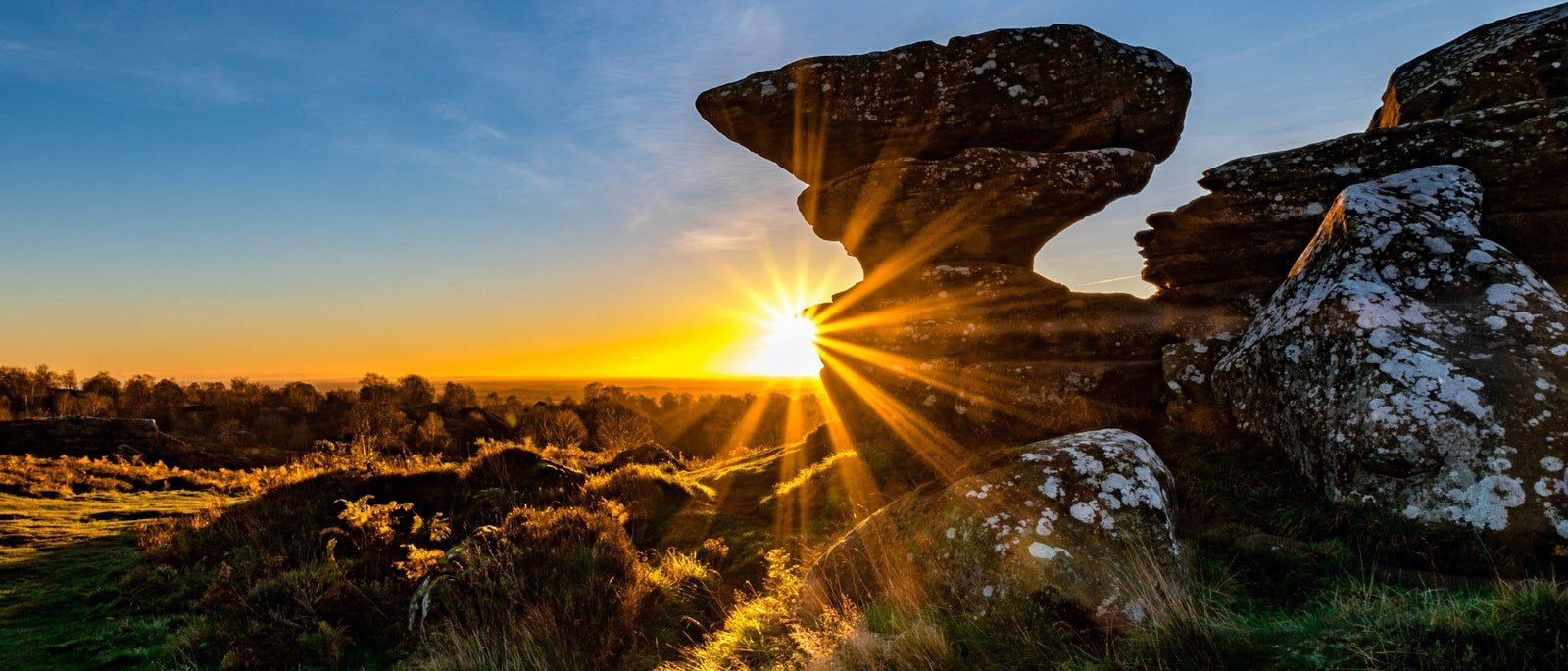
Brimham Rocks near Harrogate are otherworldly millstone grit formations created from sand compressed beneath ancient seas, followed by geological upheaval, glacial action and millennia of weathering – creating natural sculptures that baffled Georgian and Victorian visitors.
Brimham Rocks, Summerbridge, Harrogate
Some 320 million years ago, long before dinosaurs evolved, sand accumulated at the bottom of a shallow sea covering this land. Under immense pressure, that sand compressed into rock. Continental collisions later thrust the seabed skyward. Glaciers then scraped through the raised landscape, and millions of years of freeze-thaw cycles, rain and wind began breaking down the rocks. Because the stone varied in strength and thickness, weathering created the fantastical shapes visible today. Without modern geological knowledge, Georgian and Victorian visitors attributed these formations to a biblical ‘great flood.’
Rock up here…
Brimham is a National Trust property reached by driving from Ripon. Follow Westgate west onto Park Street, continue straight over two roundabouts, and join the B6265 (Studley Road). After approximately 6½ miles, follow National Trust signs to the car park.
The Buttertubs near Thwaite are 24-metre-deep limestone fissures carved by thousands of years of acidic rainwater erosion. Market traders may once have lowered butter into these natural refrigerators during summer months, keeping their goods cool in the depths where temperatures remain consistently lower than the surface.
The Buttertubs, Thwaite
Peering down these 24-metre limestone crevasses is distinctly unnerving. Over thousands of years, acidic rainwater seeped into cracks in the soft carboniferous limestone, eroding the weaker layers and creating ever-deeper fissures. The name’s origin remains uncertain, though some local historians have posited that market traders may have lowered butter into the cool depths during summer months. The temperature inside these natural refrigerators would have kept the butter from spoiling in the heat.
Rock up here…
Start from the Green Dragon in Hardraw before cycling, walking or driving the four-mile stretch to the Buttertubs. Take Bellow Hill East, then turn left following signs to Simonstone and Muker (via Buttertubs). Continue until pulling in at coordinates 54.36005, -2.1952. The Buttertubs appear on either side of the road.
Dinosaur Egg Beach at dusk: Porth Nanven's remarkable ovoid boulders were polished by prehistoric seas, then embedded in the cliff's raised beach above. They gradually erode out and tumble onto the foreshore.
Dinosaur Egg Beach, Porth Nanven
Porth Nanven is a wonderfully eccentric place – reached via a winding lane where subtropical plants flourish as emus and llamas graze nearby fields. The beach itself is strewn with hundreds of rounded boulders resembling dinosaur eggs, though these stones tell a different prehistoric story. Around 120,000 years ago, when sea levels were much higher, these cliffs sat underwater. Wave action polished the rocks in turbulent storms, depositing them on what became the cliff face. Over millennia, they compressed into the cliff’s raised beach. Today, erosion releases the ancient boulders onto the modern beach below, creating this remarkable geological display.
Rock up here…
Though parking exists at the beach, the access lane is a narrow single track, which means that walking or cycling is a much better option. From St Just, reach Lafrowda Car Park, turn left (facing the library), then right at the junction before turning left past the school. Stay on this lane to the coast.
Gairnshiel Bridge on the Old Military Road in the Cairngorms National Park. Just beyond this historic crossing lies the Ringing Stone, a silica-rich granite slab that rings like a church bell when struck – one of the world's naturally occurring lithophones.
Ringing Stone, Gairnshiel Lodge
This musical oddity sits tucked away near a small stone bridge in the Cairngorms, on the Old Military Road that cuts through the park. When struck with a hammer or stone, this silica-rich granite slab rings like a church bell. The stone’s composition and its elevated position – raised off the ground with a hollow underneath – likely contribute to its acoustic properties. These naturally occurring lithophones exist worldwide, from Western Australia to Pennsylvania. Closer to home, you’ll also find one on Tiree as well as a stone xylophone at Keswick Museum in the Lake District.
Rock up here…
From Gairnshiel Lodge, head north on the Old Military Road for just over ½ mile. Look for a stone bridge on a parallel road to the left. A path leads up to the stone atop a small bracken-covered mound before the bridge. Use mapping software to navigate to coordinates 57.0997, -3.1573 for the precise location.
Iguanodon footprint at Compton Bay, Isle of Wight. This three-toed trace dates from the prehistoric period when this coast was a muddy tidal estuary. The footprint filled with sand, fossilised over time, and now resurfaces on the beach.
Dinosaur Footprints, Compton Bay, Isle of Wight
Millions of years ago, the Isle of Wight formed part of a vast tidal estuary where diverse dinosaur species lived along muddy riverbanks. The combination of abundant dinosaurs and preserving estuarine mud makes the Isle of Wight one of Britain’s premier locations for dinosaur footprints. At Hanover Point (east of the car park), you’ll find prints from sauropods – huge plant-eating dinosaurs with round feet. Compton Bay reveals beautifully preserved three-toed prints from small theropods, the group that included Tyrannosaurus Rex and Velociraptors.
Rock up here…
Navigate to the National Trust Car Park at Compton Bay, PO30 4HB. Walk down to the beach and turn left. The prints are best viewed at low tide.
All images via Adobe Stock.
Dave Hamilton is a writer, photographer, forager and explorer of historic sites and natural places. He is the author of multiple books, including "Where the Wild Things Grow: the Foragers Guide to the Landscape", “Wild Ruins” and “Wild Ruins BC”. His latest book, “Weird Guide Britain”, published by Wild Things Publishing, is out in May 2026.