
Camp
  • The Ultimate Guide to Filtering & Purifying Water

    Turbidity, parasites, bacteria, viruses and chemical pollutants – there are five reasons that innocent-looking stream might make you ill. Here’s what can lurk in wild water, and how to make sure it’s safe to drink.

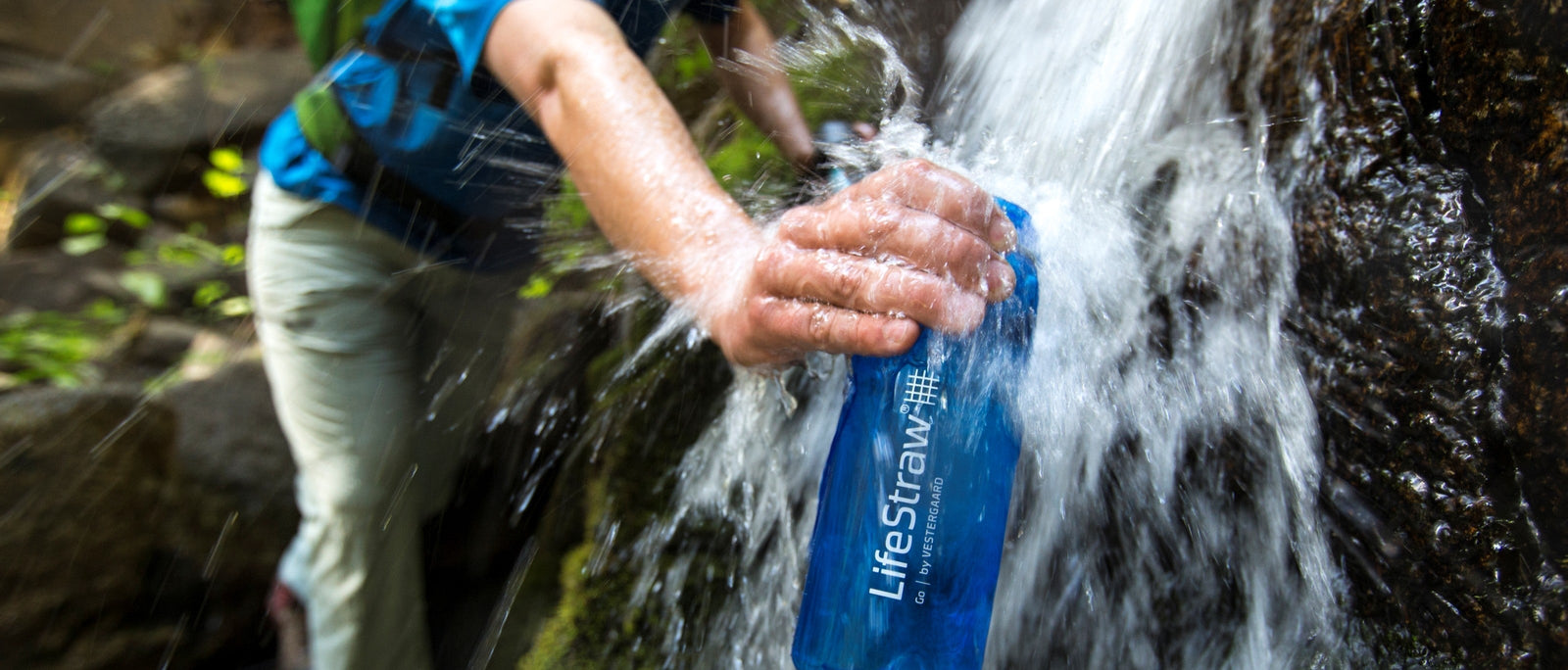
    Hand filling a LifeStraw Go filter bottle from a cascading waterfall. Wild water is everywhere in the hills – the trick is knowing what's in it.

    27th May 2026 | Words by Joly Braime @ WildBounds HQ


    You may have filled a bottle straight from an icy cold mountain stream and necked it without a second thought. But ‘looks clean’ and ‘safe to drink’ are two very different things, and every year backpackers, wild campers and travellers pick up nasty stomach bugs from water that appeared to be perfectly clean and clear.

    Whether you’re wild camping in the Lakes, backpacking a multi-day route through the Scottish Highlands, or filling your bottle from a tap in a hostel on the other side of the world, understanding what might be lurking in your water – and how to deal with it – is one of the most useful pieces of outdoor knowledge you can have. It’s also one of the most misunderstood, thanks to marketing copy that throws around words like ‘filter’ and ‘purifier’ as though they’re interchangeable. They’re not, and the difference genuinely matters.

    Katadyn BeFree bottle being filled to filter water from a rocky mountain stream.

    The Katadyn BeFree in action – fill, squeeze and drink.


    This guide breaks down the five categories of contaminant you might encounter, explains the methods (and gear) used to deal with them, and looks at when you actually need to treat your water in the UK hills versus further afield. We’ll finish with a quick-fire FAQ covering the questions we hear most often from wild campers and backpackers.

    When to Carry a Water Filter

    If you’re only out on a day hike, you can usually carry enough water to stay hydrated all day long – say, up to 3 litres in bottles, soft flasks and/or a hydration reservoir/bladder. In this case, you may not need to worry about filtering your water at all.

    However, it’s impractical to carry large volumes of water on wild camping overnighters or multi-day backpacking trips. For one thing, water is heavy (1 litre weighs 1kg), adding unnecessary weight to your pack. And if you’re camping, you’ll need water for more than just drinking – it’s also needed for cooking, cleaning, and making morning or evening brews. In the hills, you’ll often be miles away from a mains water supply. In these situations, packing a water filter or purifier allows you to safely drink from natural sources such as springs, streams and tarns/lakes, reducing pack weight while still ensuring sufficient hydration.

    The 5 Types of Water Contaminants

    Before choosing any filter or purifier, it helps to know what you’re actually trying to remove (and why). Water treatment specialists generally group waterborne nasties into five categories, and each one calls for a slightly different approach.

    Turbidity

    Turbidity simply means cloudy, peaty or discoloured water, caused by suspended silt, mud, sand or other sediment. It isn’t necessarily dangerous in itself, but it can upset your stomach, and it also reduces the effectiveness of chemical treatments and clogs filter membranes faster. If a source looks murky, letting it stand so particles settle, or running it through a coarse pre-filter (like a Millbank bag) or bandana first, will make whatever treatment comes next work far better.

    Parasites (Protozoa)

    These are microscopic single-celled organisms, the best-known being Giardia and Cryptosporidium. Both are commonly linked to contamination from livestock and wild animal faeces, which makes them a genuine consideration on UK grazing land as much as anywhere else in the world. Some protozoa form tough, dormant cysts that survive for long periods in cold water and are notoriously resistant to certain chemical treatments, though not to filtration or a rolling boil.

    Bacteria

    Bacteria are smaller still, and they are the group responsible for illnesses ranging from mild traveller’s diarrhoea to more serious infections such as typhoid and cholera in regions with poor sanitation. E. coli is the one most UK campers will have heard of, often linked to agricultural run-off and slurry. Luckily, bacteria are straightforward to remove with any standard microfilter.

    Viruses

    Viruses are smaller again, measured in nanometres rather than microns, and this is where things get tricky. Many standard water filters simply aren’t fine enough to physically block them. Instead, you need a purifier (see below). Viruses such as Hepatitis A and norovirus are usually associated with human faecal contamination, which makes them a bigger concern when travelling somewhere with limited sanitation infrastructure than they typically are on a remote UK hillside.

    Chemical Pollutants

    This catch-all category covers everything else, from agricultural pesticide run-off to heavy metals leaching from old mine workings – a genuine issue in upland and coastal parts of Britain with a strong legacy of mining, as well as former industrial catchments elsewhere in the UK. Chemical contamination is invisible and won’t be dealt with by most filters; only an activated carbon stage (or, in extreme cases, reverse osmosis) will remove it.

    Water being poured from a sketchy-looking tap into a Grayl Geopress purifier at a stone trough.

    The Grayl Geopress's simple press-and-drink design makes purifying water easy, delivering viral protection in seconds, whether you’re filling from a sketchy tap or a murky river.


    Filters vs Purifiers: What’s the Difference?

    This is the single most misunderstood distinction in the whole category, and it’s worth getting straight before you spend any money. A filter physically strains water through a membrane fine enough to catch protozoa and bacteria, typically somewhere around 0.1 to 0.2 microns. That’s small enough to stop Giardia and Cryptosporidium cysts and the vast majority of bacteria in their tracks. What it can’t do is catch viruses, which are roughly ten to fifty times smaller again.

    A purifier does everything a filter does, then adds a second stage to deal with viruses too – either an even finer membrane (down around 0.02 microns), a chemical treatment, UV light, or some combination of the above. This is why purifiers tend to be more expensive, and often slightly slower or more involved to use.

    Contaminant Standard Filter Purifier
    Turbidity Reduced (best pre-filtered first) Reduced (best pre-filtered first)
    Parasites (Giardia, Cryptosporidium) Removed Removed
    Bacteria (E. coli, etc.) Removed Removed
    Viruses (Hepatitis A, norovirus) Not removed Removed or inactivated
    Chemical pollutants Only with an activated carbon stage Only with an activated carbon stage

    In practice, this means a standard filter is generally all you need for backpacking and wild camping within the UK, where viral contamination of freshwater is comparatively rare. Head further afield, particularly anywhere with limited sanitation, or if there’s a chance you’ll be drinking from a tap rather than a mountain stream, and a purifier becomes the safer choice.

    Water Treatment Methods Explained

    These days, mechanical filtration is the most popular approach for backpacking. Typically, this is some form of modern microfiltration using a hollow-fibre membrane packed with thousands of tiny pores. Water is forced through by squeezing a soft flask, pumping a lever, the action of gravity, or simply sucking through a straw. It’s fast, chemical-free and doesn’t affect taste, but on its own it won’t remove viruses or dissolved chemicals.

    Chemical treatment uses tablets or drops, most commonly chlorine dioxide or iodine, to kill or deactivate pathogens. Chlorine dioxide is effective against bacteria, viruses and, given enough contact time, protozoa; iodine is less reliable against Cryptosporidium and isn’t recommended for pregnant women, anyone with a thyroid condition, or prolonged use. Both leave a noticeable taste and need time to work, typically thirty minutes to four hours depending on water temperature.

    UV purifiers, such as pen-style devices you stir through your bottle, scramble the DNA of pathogens so they can’t reproduce. They’re quick and leave no aftertaste, but they need clear water to work properly (turbidity blocks the UV light), they rely on batteries, and won’t remove sediment or chemicals.

    Boiling remains the one method that deals with every biological contaminant, at any altitude – water only needs to reach a rolling boil, as pathogens are destroyed well below that temperature even where the boiling point itself is lowered at elevation. What boiling won’t do is remove turbidity, improve taste, or deal with chemical pollutants, and it costs you time and fuel. If you’re moving quickly with minimal kit, you might also be loath to carry a stove, a pot and a gas canister.

    Activated carbon isn’t a standalone treatment for pathogens, but it’s the only widely available method for removing chemical pollutants, heavy metals and pesticides, and it dramatically improves taste. Most quality filters and purifiers now build an activated carbon stage in alongside their main filtration method.

    Hiker filling a water purifier from a stream on foggy upland moorland.

    Remote doesn't always mean safe – sometimes it’s worth treating wild water regardless of the setting.


    When Do You Actually Need to Treat Water in the UK?

    This is genuinely a judgement call, and it depends on where you’re drawing water from. Small headwater sources, like upland springs, streams or lakes/tarns fed directly by boggy moorland, well above the highest fields and away from livestock, carry a lower risk than lowland rivers and lakes, which can be affected by agricultural run-off or sewage overflow discharges, which have become a topical issue in British waterways in recent years. That said, sheep, deer and even cattle graze surprisingly high up across Snowdonia, the Lakes and much of Scotland, so protozoan and bacterial risk exists even in the mountains. In parts of Wales and Cornwall, the legacy of historical mining activity adds a chemical dimension that filtration alone won’t solve.

    If you’re wild camping on Dartmoor or in the Scottish Highlands, you’ll often be filling up from exactly the kind of small headwater source that might seem perfectly safe. Even here a simple filter earns its keep though. Our general advice: when in doubt, treat it. A lightweight filter weighs next to nothing and the alternative is a ruined trip.

    Woman using a Grayl Geopress water purifier in a shallow jungle pool.

    Further afield, the risks change – and so should your kit. Stepping up to a purifier with in-built viral filtration can be a wise move.


    When You’re Travelling Further Afield

    Adventure travel raises the stakes considerably. Tap water potability varies enormously by country, sanitation infrastructure can’t be assumed, and the viral risk profile is much higher than on a UK hillside, particularly for Hepatitis A and norovirus. This is where a purifier, rather than a basic filter, comes into its own, whether that’s a bottle you can fill from a hotel tap or a village standpipe, or a higher-capacity pump for expedition use. Remember, too, that ice cubes, salads washed in tap water, and even the water you brush your teeth with can all be contaminated.

    Popular Water Filters & Purifiers

    We stock a broad range of tried-and-tested options at WildBounds, spanning both filter and purifier categories. Katadyn BeFree is our go-to recommendation for UK backpacking and wild camping. Its hollow-fibre membrane, with 0.1-micron pores, removes bacteria, protozoa and sediment at up to two litres a minute, and the EZ-Clean design simply shakes or swishes clean rather than needing backflushing. It’s available from compact 500ml bottles that fit a running vest pocket right up to larger gravity systems for filtering litres at a time for a group.

    Katadyn BeFree gravity filter bag hanging from a branch, filtering water into a bottle

    Hang it, fill it, walk away – gravity systems do the work for you. This makes them a great choice for basecamp use or if filtering water for a larger group.


    For anywhere a purifier is the sensible choice, the Grayl GeoPress is one of the most popular options we sell. Fill, press and drink: it delivers 700ml of purified water in around eight seconds, using a two-stage process that protects against viruses, bacteria and protozoan cysts, while also filtering out chemicals, heavy metals and microplastics. The smaller UltraPress offers the same protection in a lighter, more packable format.

    At the more heavy-duty end sits the MSR Guardian Purifier Pump, developed from military-grade technology and built for expedition use, group trips and travel in demanding conditions. Its 0.02 micron hollow-fibre membrane removes viruses, bacteria, protozoa and sediment, the pump self-cleans on every stroke to resist clogging, and it delivers a genuinely fast flow rate of around 2.5 litres a minute. You’ll find the full MSR range on our site.

    Pump-action water filter in use beside a lake, filling a bottle

    A pump filter earns its keep on longer, harder-working trips.


    There’s also the Katadyn Explorer, with a two-stage ceramic-and-carbon filtration platform. The ceramic cartridge handles bacteria, protozoa, cysts, microplastics, and sediment across a rated capacity of up to 20,000 litres, while the activated carbon stage takes care of taste and odour. It’s field-cleanable and stores dry between outings, so it’s ready to go whenever you are. A steel pump piston keeps things reliable in harsh conditions, and the modular design means it can be upgraded to full Pro spec [link] down the line, which adds full viral purification capability should your adventures take you to more remote places. At 480g it’s a dependable workhorse for almost any trip – and if you eventually find yourself somewhere the water demands more than a microfilter can handle, the Pro Upgrade Kit [link] has you covered.

    Hiker drinking directly from a stream through a LifeStraw personal filter

    Sometimes the simplest option is all you need – the original LifeStraw filters water straight from source to mouth.


    Lastly, the LifeStraw remains the byword for straightforward, budget-friendly filtration. The original straw is a brilliant emergency backup, while the Go bottle range builds the same filter into an everyday drinks bottle, and the Peak Series gravity system makes light work of filtering water for a group at basecamp.

    LifeStraw Go filter bottle being filled from a stream below a granite valley

    For added versatility, the LifeStraw Go acts as both filter and handy drinks bottle.


    Whichever filter or purifier you choose, pairing it with a Platypus reservoir or bladder gives you somewhere to store treated water for the trail ahead.

    Frequently Asked Questions

    Can I drink straight from a Scottish loch or Welsh mountain stream?

    Sometimes, but it’s a risk rather than a guarantee. Remote headwater sources well above livestock are generally lower risk, though never zero risk given wild animals, cyst-forming parasites and other unknowns. A lightweight filter removes almost all of that uncertainty for very little weight or effort, so it’s hard to justify not carrying one.

    Choosing the best possible source also reduces contamination risk:

    • Look for headwater sources such as springs (marked ‘Spr’ on OS maps) or collect it as high up as you can, from fast-moving sources like streams or rivers rather than stagnant pools.
    • Collect water upstream of (i.e. higher up than) campsites, trails, or grazing livestock.
    • Avoid water sources near human activity, farmland and industrial areas.
    • Avoid algae-covered sources.

    Do I need to filter tap water at UK campsites?

    No. Mains tap water in the UK is treated to a high standard and is safe to drink straight from a campsite tap. Filtration and purification are for wild, untreated water sources, not the public supply.

    Is boiling enough, or do I need a filter too?

    Boiling deals with every biological contaminant on its own, but it won’t remove turbidity, chemicals, or improve taste, and it costs fuel and time. Many backpackers use filtration as their everyday method and keep boiling in reserve as a backup if a filter fails.

    Two Katadyn BeFree filter bottles and a replacement filter cartridge on wet rocks

    A slower flow rate is your cue to clean – flushing the Katadyn BeFree cartridge is simply a case of swishing it in fast-flowing water.


    How do I know when to replace my filter cartridge?

    Most manufacturers state a lifespan in litres, typically anywhere from 1,000 litres for a hollow-fibre filter to around 250 litres for a purifier cartridge such as the GeoPress. A noticeably slower flow rate is usually the first sign it’s time for a replacement, even before you hit the stated limit.

    Will a jug-style home filter work for backpacking?

    No. Domestic jug filters like Brita filters are designed to improve the taste of already-treated tap water by removing chlorine and limescale; they aren’t rated to remove bacteria, protozoa or viruses and shouldn’t be relied on for untreated wild water.

    Do filters or purifiers remove chemical pollutants?

    Only if they include an activated carbon stage. Filtration and purification methods that rely purely on membrane pore size or chemical/UV treatment won’t touch dissolved pollutants such as pesticides or heavy metals, so check the specification if this is a concern in your area.

    What’s the best all-rounder for UK backpacking?

    For the vast majority of UK wild camping and backpacking, a lightweight hollow-fibre filter such as the Katadyn BeFree strikes the best balance of weight, speed and protection. Reach for a purifier such as the Grayl GeoPress or MSR Guardian if your trip involves travel further afield, or water sources you’re less confident about.


    Vollständigen Artikel anzeigen

    A man and a woman lying on sleeping mats and bags on an open hillside, with a dramatic mountain cliff and wide alpine valley behind them, sharing a hot drink from a camping stove.
    Der ultimative Ratgeber für Schlafmatten und -unterlagen

    Komfort, Wärme, Strapazierfähigkeit, Gewicht und Packmaß: Bei der Auswahl der richtigen Isomatte gibt es viel zu beachten. Ganz gleich, ob Sie Ihre erste Isomatte kaufen oder Ihre abgenutzte Ausrüstung aufrüsten möchten – hier finden Sie alles, was Sie wissen müssen.

    Camping Gas Explained | Camp Notes | WildBounds UK
    Camping Gas Erklärt

    Welches Gas eignet sich am besten für Camping und Rucksacktouren? Welche Gaskanister funktionieren mit meinem Kocher? Und wie lange hält eine Gasflasche? Alle Ihre brennenden Fragen über Campinggas werden beantwortet...

    Inserting a NEMO Airpin – an evolution of the tried and tested needle stake design – into stony ground.
    Haltekraft | Der ultimative Leitfaden für Zeltheringe und Pflöcke

    Welche Zeltheringe eignen sich am besten für Rucksacktouren und Wildcamping? Wir erklären Ihnen alles, was Sie wissen müssen, und stellen die besten Designs für verschiedene Bodenbedingungen vor, damit Sie sich immer eines soliden Standplatzes sicher sein können.