
Camp
  • Picking the Perfect Pocket Knife

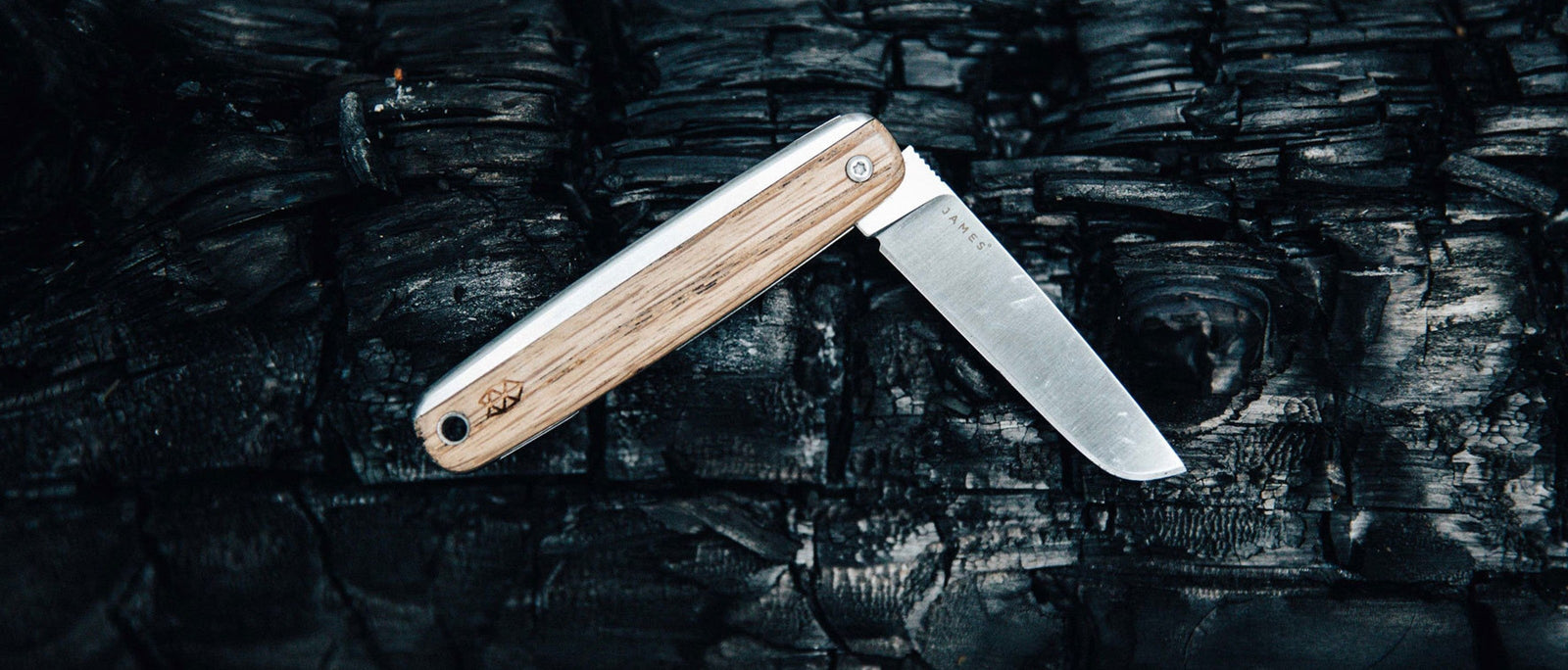
    Wooden-handled folding pocket knife by The James Brand with a straight blade, partly open on a charred log.

    2nd October 2026 | Words by Matt Jones @ WildBounds HQ


    A knife comes in handy for all sorts of everyday jobs, especially if you’re heading out on the trail or camping for the weekend. Before you get carried away, we’re not suggesting you strap a giant bowie knife to your thigh in case things turn into a Bear Grylls-style survival situation. Even the soggiest wild camping weekend rarely goes that wrong.

    What we’ve found most useful is a compact, non-locking folding knife that can handle plenty of small but important jobs. Most of them involve food: opening a packet without ripping it apart and showering your tent with couscous, say, or slicing cheese, dicing a hunk of chorizo and chopping fruit and veg. A small, single-bladed knife is also handy for cutting thread, string, paracord or gear tape when you’re making field repairs to a tent, sleeping mat or rucksack. And it earns its place in a first aid kit, for trimming dressings and bandages to size.

    Compact black-bladed TACTICA folding knife with a textured black handle, resting in an open palm

    The TACTICA K.150 Micro Folder: small enough to forget about – until you need it.

    You could carry a Swiss Army Knife instead, or a Leatherman-style multitool with a whole toolbox of extras. The catch is that they’re bulkier and heavier than a slim, single-bladed knife, and you’ll notice that weight at the end of a long day.

    Likewise, if your camping leans towards bushcraft – building natural shelters, processing firewood or gutting fish and game – you’ll want a heftier fixed-blade knife.

    Compact black-bladed TACTICA folding knife with a textured black handle, resting in an open palm

    When the camp tasks get more serious, you may want to step up to a fixed blade like the TACTICA K.300. Just be aware that you need a valid reason to carry a knife like this in the UK.

    Is a pocket knife legal in the UK?

    A compact, non-locking folding knife packs a surprising amount of cutting power into a small package, and they keep you on the right side of the law. In the UK, you can legally carry a non-locking pocket knife with a blade up to 3 inches (7.62 cm) without needing a specific reason. It isn’t illegal to carry larger locking folders or fixed blades, but you’ll need a good reason to carry them.

    Honestly, this is all the knife most campers and backpackers will ever need. If you’re after a UK-friendly knife for your EDC or backpacking kit, then a small, non-locking folder is hard to beat: light enough to forget about, sharp enough for every job in camp or on the trail.

    Before you buy, it helps to know what you’re looking at. Here’s a quick guide to the terms you’ll come across.

    Close-up of The James Brand Folsom's stonewashed blade, with the VG-10 steel marking etched at its base

    Check the blade – any high-quality knife will usually tell you what type of steel it’s made from. The James Brand’s Folsom pictured here uses VG-10, a Japanese stainless steel with added chromium and vanadium for improved blade strength.

    Blade steels

    The steel matters more than anything else on a knife. The blade is the business end, after all, and the steel largely decides how well it cuts, how long it stays sharp and how it copes with life in a damp rucksack. Steel is essentially iron with a little carbon, plus traces of other elements such as manganese, chromium, molybdenum and vanadium, each of which tweaks how it behaves. That adds up to thousands of different steels, but for knives they fall into two broad camps, with a halfway house in between:

    Carbon steel

    The traditional choice before stainless came along. It’s easy to sharpen, which is exactly what you want in a blade, but it will rust if it’s left exposed to moisture and oxygen. You’ll soon spot it discolouring.

    Stainless steel

    Now used for everything from tools to cutlery. It contains chromium to help keep rust at bay, though even stainless can rust eventually if neglected.

    Semi-stainless steel

    A halfway house, with enough chromium to resist rust better than carbon steel but not enough to count as properly stainless. D2 tool steel is a popular example: it holds an edge superbly, but it’s worth giving it a wipe-down after a wet day.

    Which to choose

    If you’re likely to use your knife in wet weather – and this is Britain, so you probably will – stainless is the sensible choice. There’s a reason marine knives are all stainless. If you want a blade that’s easy to sharpen in the field and holds its edge well, carbon steel could be the better bet.

    Steels are usually judged on five things: hardness, toughness, edge retention, wear resistance and corrosion resistance. No steel scores top marks in all five, so look for a sensible balance or prioritise whatever matters most to you.

    Hardness – Occasionally known as blade strength, though hardness is more common. The harder the steel, the less likely it is to deform/bend in use. It is generally measured using the Rockwell C scale (aka “HRC”).

    Toughness – The steel’s ability to resist damage like cracks or chips, as well as its ability to flex without breaking. Typically, increased toughness means decreased hardness.

    Edge Retention – How long the blade will stay sharp. Edge is really important to knife performance but is extremely hard to measure objectively.

    Wear Resistance – The steel’s ability to withstand abrasion and adhesion. Wear resistance generally correlates with the steel’s hardness but is also heavily influenced by the specific chemistry of the steel, particularly its carbide properties.

    Corrosion Resistance – basically, resistance to rust. Proper knife care and maintenance will help prevent rusting. Unfortunately, increased corrosion resistance usually means decreased edge retention and quality, since stainless steels are harder to sharpen than carbon steels.

    A handy tip when picking a pocket knife is to check the blade for markings, which usually tell you what it’s made from. Be wary of anything simply stamped ‘stainless’ or ‘surgical steel’, which generally signals a poor-quality blade. Look for a named alloy instead. 13C26, 440C, CTS-BD1, AUS-8, 8Cr13MoV, 12C27 and VG-10 are common examples, while S30V, S35VN and S90V sit at the posher end of the scale. So does LC200N, a ‘super stainless’ that shrugs off corrosion better than almost anything else.

    Close-up of the ridged jimping on The Folsom Pro's spine, beside the thumb hole and grooved black handle

    Jimping is the name given to the ridges and grooves machined into the spine of a knife, providing secure grip exactly where your thumb wants it.

    Parts of a knife blade

    You don’t need to memorise these, but they crop up in most knife descriptions.

    Point or tip

    As the blade tapers along its length, it finishes in a point or tip. A long, thin tip is good for piercing, but a blunter one is handier for general cutting, especially if you’d rather not puncture anything (yourself included). Long tips are also delicate and prone to snapping.

    Spine

    The blunt, back edge of the blade. It can be straight or curved. A thin blade has a narrow spine, which suits precise cutting, while a thicker spine is better for heavier-duty jobs.

    Jimping

    Your thumb will often rest on the spine for extra control, so the base of the spine usually has a ridged or raised pattern to help it grip. That’s jimping.

    Ricasso

    The unsharpened section at the base of the blade, where it meets the handle.

    Edge

    The sharpened part (or parts) of the blade, also known as the cutting edge.

    Bevel

    The angle at which the blade is ground to create the cutting edge. You’ll find a bevel on both sides of the blade, or on just one side in the case of a chisel grind.

    Belly

    The area of the blade between the spine and the cutting edge. It gives a knife its heft and has a big effect on how it cuts.

    Choil

    The indentation between the base of the cutting edge and the ricasso (or, on some knives, the handle). It makes it much easier to sharpen the full length of the edge. Some knives also have an oversized choil or a groove for your index finger, which doubles as a safety feature on non-locking folders and makes for a more comfortable grip.

    Blade shapes

    Blades come in all sorts of shapes, many designed for specific jobs. On pocket knives, these are the ones you’ll meet most often:

    Drop point

    The spine curves gently down to the tip in a convex curve. It’s a good-looking, versatile and durable shape, and a very sound all-rounder.

    Clip point

    A traditional shape with a concave curve towards the tip. It looks as though the top edge of the blade has been ‘clipped’ off, hence the name. The narrow tip is great for close, precision cutting and piercing, though it’s a little weaker than other shapes.

    TACTICA K.100 pocket folder with a black tanto blade, partly open on a bed of wood chips

    The TACTICA K.100’s tanto blade: tough tip, no-nonsense angles.

    Tanto

    Inspired by the blade of a Japanese samurai sword, a tanto has two angled cutting edges and an extremely strong tip that’s good for piercing.

    Spear point

    Another traditional style, with a distinctive symmetrical profile that’s ideal for slicing and cutting.

    Sheepsfoot

    A proper working blade, originally developed for trimming sheep’s hooves. It has a straight cutting edge, a straight spine and a rounded tip, which minimises the risk of accidentally piercing whatever you’re cutting. It’s considered a very ‘safe’ blade, good for all manner of jobs. In the kitchen, you’ll know it as a paring knife.

    Folding knife with a rosewood handle and a straight-edged Wharncliffe-style blade, laid out among EDC gear

    The James Brand’s Wharncliffe's elegant fine tip is all about control.

    Wharncliffe

    A close relative of the sheepsfoot, with the same straight cutting edge, but the spine curves down to a fine tip. It isn’t quite as robust, but it offers terrific precision and control for fine work.

    Straight back

    The classic ‘kitchen knife’ shape, with a straight spine and a cutting edge that curves up towards the tip. It’s a versatile all-rounder for cutting, slicing and piercing.

     Curved hawkbill blade of an Old Bear folding pruner knife, resting against a log

    A classic hawkbill: happiest when cutting tangled vines, cord and overgrown allotments.

    Hawkbill

    Named after the hooked beak of a bird of prey, this blade curves sharply downwards, with the cutting edge on the inside of the curve. It pulls whatever you’re cutting towards the handle, which makes it superb for pruning, trimming vines and cutting cord, and the classic choice for garden and allotment knives. It isn’t the one for slicing cheese, though.

    Knife grinds

    The grind shapes the cutting edge and largely decides how it performs. On pocket knives, you’ll usually find one of these:

    Hollow grind

    A concave profile that leaves a very thin cutting edge – think razor. It’s ideal for slicing and precision work and is easy to sharpen, but the edge is delicate and prone to rolling over.

    Flat grind

    A triangular profile that tapers at a constant angle from the spine towards the edge. If it tapers all the way from the spine, it’s called a full flat grind; if only part of the way, it’s sometimes known as a sabre grind. It’s the most common grind, as it’s fairly strong and good-looking.

    Chisel grind

    Bevelled on one side only, just like a chisel. It makes for a strong blade that’s easy to sharpen and, depending on which side is bevelled, can be good for slicing, as the shape tends to push material away from the blade.

    Convex grind

    Rounded towards the cutting edge, with no secondary bevel – the angle of the grind runs right up to the edge. It can make for exceptional blades, but it’s difficult to apply evenly and just as tricky to sharpen.

    Scandi grind

    A favourite of Scandinavian makers such as Mora, Marttiini and Fallkniven, the Scandi grind is a classic bushcraft choice. It gives a thick, strong, wedge-shaped blade that’s ideal for carving and splitting wood. It’s easy to sharpen, but the wide bevel means that if you chip the edge, you may need to remove a lot of metal to put it right.

    Edge types

    Alongside the grind, you’ll often see a choice of edge. It’s worth thinking about what you’ll be cutting before you pick one.

    Plain edge

    The smooth, straight edge you’ll find on most pocket knives (sometimes listed as ‘straight’). It’s best for clean slicing and push cuts, from cheese to cord, and it’s the easiest to sharpen.

    Old Bear folding knife with a walnut handle and serrated blade, open on a coil of rope

    Serrations make short work of cutting rope or tough fabrics like seatbelts, so they’re ideal knives for climbing, emergency rescue and survival.

    Serrated edge

    A row of scalloped teeth, like a bread knife. Serrations tear through rope, webbing and other tough, fibrous materials in a hurry, but they’re fiddly to sharpen and make a mess of tomatoes.

    Part-serrated edge

    A combination of the two, usually with a plain section near the tip for precise work and serrations nearer the handle for the heavy lifting. It’s a handy compromise if you can’t decide.

    Hands cutting orange paracord with a black part-serrated folding knife

    The James Brand’s Redstone is a climbing knife with serrations at the base for cord or rope, plus a plain edge at the tip for other tasks.

    Folding mechanisms

    Folding knives fall into two camps: those that lock open and those that don’t. Starting with the non-locking kind, these are either slipjoints or friction folders:

    Slipjoint

    The catch-all term for any non-locking folder that uses a backspring to hold the blade open when it’s unfolded and closed when it’s folded. The backspring gives enough stiffness for effective use. Some slipjoints also have extra detents that ‘stop’ the blade at 45 and/or 90 degrees, helping to prevent it closing on your fingers. These are known as quarter-stops or half-stops.

    Friction folder

    A much simpler design, usually found on cheaper non-locking folders, which relies purely on friction between the blade and the handle to keep the knife open or closed.

    Locking knives hold the blade firmly in place until you release it, which makes them safer for heavier cutting. Just bear in mind that in the UK you’ll need a good reason to carry one. These are the main types:

    Liner lock

    A springy metal strip (the liner) inside one handle scale swings across behind the blade when it’s opened, wedging it in place. To close the knife, you push the liner aside with your thumb. It’s simple, affordable and easy to use one-handed, which is why it’s so common.

    Frame lock

    The same idea as a liner lock, except the locking piece is cut from the handle frame itself, usually in titanium or steel. That makes it chunkier and stronger, though you’ll generally pay more for it.

    Hand holding a folding knife with a black textured handle, the slide lock button visible on the scale

    Slide lock: one thumb to lock, one thumb to release.

    Slide lock

    A spring-loaded bar or button slides across to lock the blade open, and you slide it back to release. It’s ambidextrous and easy to operate with either hand, and it keeps your fingers out of the blade’s path when closing the knife.

    Close-up of an Old Bear brass collar lock, showing the slotted ring, steel spring catch and olive wood handle

    Collar lock: a brass ring that keeps the blade honest.

    Collar lock

    A collar at the base of the blade locks it in place, open or closed. It’s simple and secure, with no complex springs, and few moving parts.

    Opening styles

    How you get the blade out matters more than you might think, especially with cold or wet hands.

    Nail nick

    A small groove in the blade that you catch with your thumbnail. It’s the traditional choice on slipjoints, and it needs two hands.

    Thumb stud

    A small peg on the blade that you push with your thumb to swing it open. It’s quick and easy to use one-handed.

    Thumb disc

    A flat, round disc on the spine of the blade, which does the same job as a stud. Many are symmetrical, so they work equally well for right- and left-handers.

    Thumb hole

    A hole drilled through the blade for your thumb to push against. It’s a simple, reliable design with nothing to snag in your pocket.

    Blue James Brand Redstone with a part-serrated blade, thumb hole and wire pocket clip

    The James Brand’s Redstone features a thumb hole, slide-lock blade mechanism, versatile drop point blade in Sandvik 12C27 steel and tough, grippy polypropylene scales.

    Handles

    The handle plays a big part in a knife’s looks, but it also largely decides how comfortable the knife is to hold and use (its ergonomics). Some knives have a one-piece handle, usually plastic or wood, with the blade folding into a groove or slot in the underside.

    Most folders have a multi-part handle, typically two scales that sandwich the blade when it’s folded. These are held together by rivets, screws or pins, and may have bolsters capping one or both ends. Inside, you might find liners, a backspacer and a backspring. Some knives have a pocket clip for secure carry, while others have lanyard holes so you can thread them onto a loop of cord.

    Handles and scales can be made from plastic polymers, wood, bone, antler, carbon fibre or metals such as steel and aluminium. These are the terms you’ll see most:

    FRN (fibreglass-reinforced nylon)

    A plastic polymer reinforced with glass fibre and injection moulded. It’s cheap to produce on a mass scale but very durable. The higher the glass content, the stiffer the nylon.

    Slim folding knife with a black canvas Micarta handle, open across a coffee cup on a bed of coffee beans

    The James Brand’s Wayland features micarta scales that are tactile, tough and good at ageing – elevated with blackened titanium bolsters and a lanyard hole.

    Micarta

    A resin laminate made from layers of resin-soaked paper, canvas or linen. Once hardened, it’s very strong but keeps a tactile feel, and it can be finished in lots of different patterns and textures. Some types also weather over time, developing a natural patina.

    G10

    Also a resin laminate, but made by soaking layers of glass cloth in epoxy resin, then compressing and heating them until they set. The result is impervious to moisture and can be dyed in lots of colours. It can be finished in numerous ways too, either textured for extra grip or bead blasted, sanded and polished for a sleek sheen.

    The James Brand Carter with woven carbon fibre handle scales, a silver pocket clip and a drop point blade

    Carbon fibre: strong, light and a little bit show-off.

    Carbon fibre

    Another laminate, formed from resin-soaked carbon fibre cloth. It’s exceptionally strong but very lightweight, hence its use in racing and other motorsports. It turns up in high-end knife handles partly for those qualities, and partly for its futuristic looks.

    Titanium

    Strong, light and highly resistant to corrosion, which makes it a premium choice for handles, particularly on frame locks. It doesn’t come cheap.

    Wood

    Walnut, olive and ebony are all popular for traditional knives. Wood is warm and comfortable in the hand and ages beautifully, though it needs a bit more care in damp weather than the synthetic options.

    Polypropylene

    A tough, lightweight plastic that’s grippy, practical and easy to clean.


    Vollständigen Artikel anzeigen

    Five Reasons Why a Bivvy is Better Than a Tent | Camp Notes | WildBounds UK
    Fünf Gründe Warum a Bivvy ist Besser Als a Zelt

    Wenn es darum geht, im Freien zu schlafen, entscheiden sich die meisten Wildcamper für ein Zelt. Wir sind jedoch der Meinung, dass die schönste Art, eine Nacht auf den Bergen zu verbringen, auf einem Biwaksack liegt. Hier sind fünf Gründe, warum Biwakieren besser ist als Schlafen unter einem Zelt.

    Two hikers ascending a grassy hillside trail using trekking poles for support on the climb.
    Trekking Poles Explained: The Ultimate Buying Guide

    More speed, more stability, less strain on your knees – just three good reasons why experienced long-distance hikers almost always use trekking poles. Here’s everything you need to know before buying a pair.

    Hand filling a LifeStraw Go filter bottle from a cascading waterfall. Wild water is everywhere in the hills – the trick is knowing what's in it.
    The Ultimate Guide to Filtering & Purifying Water

    Turbidity, parasites, bacteria, viruses and chemical pollutants – there are five reasons that innocent-looking stream might make you ill. Here’s what can lurk in wild water, and how to make sure it’s safe to drink.